


For Enquiry
9948984444
9247456148

SRI VISWASANTHI EDUCATIONAL INSTITUTIONS
Near Vijayawada,Vuyyuru - 521 165,
Krishna Dt. (A.P.), India
FOR MORE DETAILS GIVE MISSED CALL TO
9247456148, 9948984444
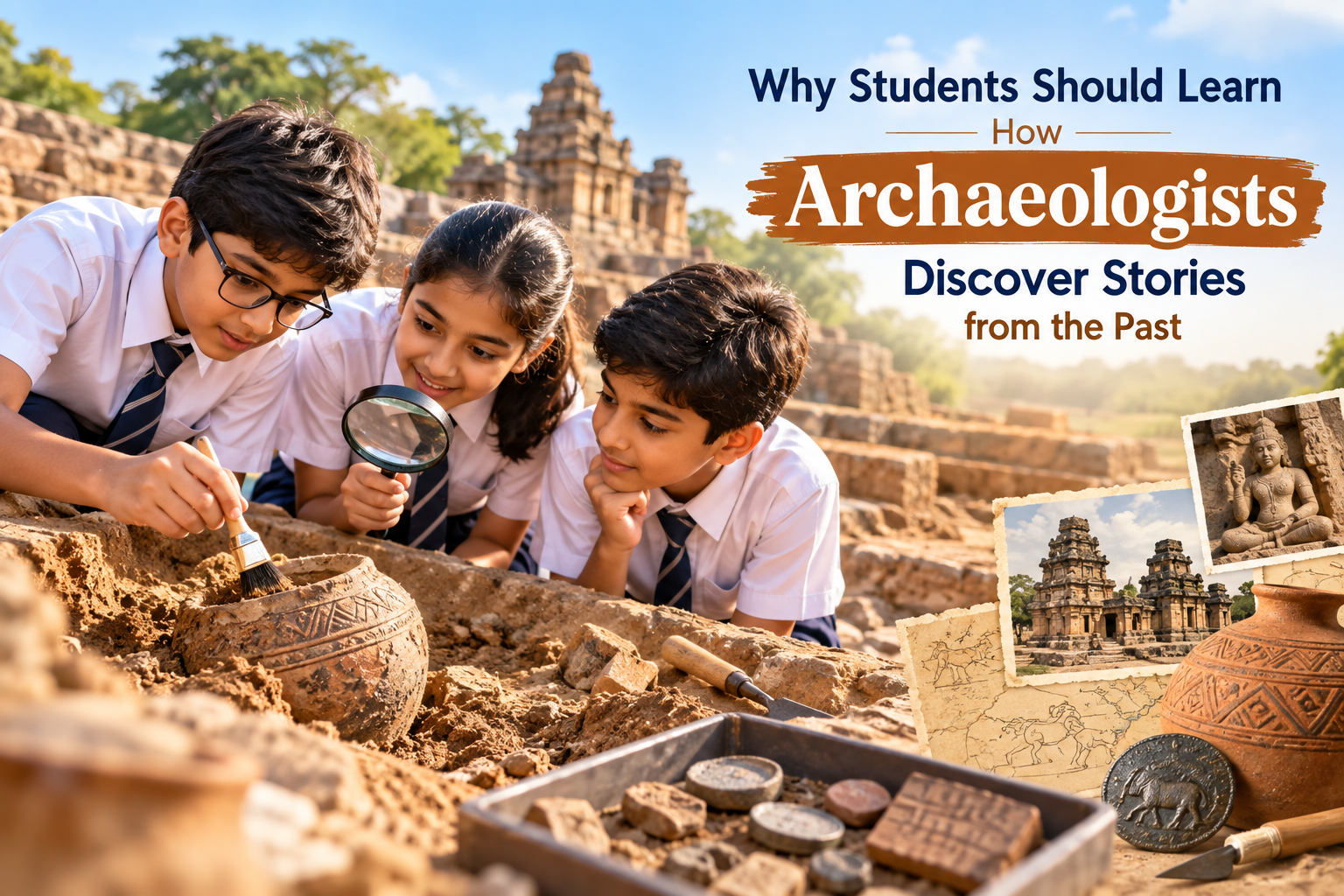
How do we know what people ate thousands of years ago? How can we understand the homes they lived in, the tools they used or the objects they valued when there were no photographs or videos to record their lives?
Many of these questions are answered through archaeology.
Archaeologists study physical evidence left behind by people from the past. From pieces of pottery and ancient coins to buildings, tools and inscriptions, even a small discovery can provide valuable information about how earlier societies lived.
For students, understanding archaeology can make history feel less like a collection of dates and more like an investigation into real human lives.
An archaeologist studies evidence from past human societies.
This evidence can include objects and structures such as:
Archaeologists carefully examine where these objects are found, what they are made from and how they may have been used.
The location of an object can sometimes be just as important as the object itself because it provides clues about the people who once lived there.
When students hear the word archaeology, they may immediately imagine someone digging in the ground looking for ancient objects.
Excavation is certainly an important part of archaeology, but it is only one stage of the process.
Before digging begins, archaeologists may study historical records, maps, photographs and the landscape itself. Modern technology can also help researchers identify possible archaeological sites.
Once excavation begins, every discovery needs to be carefully documented. Archaeologists record where objects were found and examine their relationship with other discoveries nearby.
The aim is not simply to find something old. It is to understand what that discovery can tell us about the past.
An ordinary-looking object can reveal surprising information.
A piece of pottery may provide clues about how people prepared or stored food. A coin may tell researchers about rulers, trade or economic activity. Ancient tools can show how people worked and solved everyday problems.
Even objects that may appear unimportant at first can become useful pieces of evidence.
This can teach students an interesting lesson: understanding history often requires paying attention to small details.
Determining the age of an archaeological discovery is an important part of understanding it.
Researchers may study the layer of soil in which an object was discovered or compare it with similar objects whose ages are already known. Depending on the material involved, scientists can also use specialised dating techniques.
One well-known method is radiocarbon dating, which can help estimate the age of certain materials that were once living, such as wood or other organic remains.
Students do not need to understand every scientific technique in detail to appreciate an important point: archaeological conclusions are built by examining evidence carefully.
History often introduces students to rulers, kingdoms, wars and important events. Archaeology can add another dimension by revealing aspects of everyday life.
Archaeological evidence can help researchers investigate questions such as:
What did people eat?
Remains of plants, seeds, bones and cooking vessels can provide clues.
What kind of houses did they build?
Foundations, walls and construction materials can reveal how settlements were organised.
What work did people do?
Tools and workshops can provide evidence about farming, crafts and other occupations.
How did people trade?
Coins and objects originating from distant places can indicate connections between communities.
Through these discoveries, students can begin to imagine history as the lives of ordinary people rather than only major events.
One interesting feature of archaeology is that it brings together knowledge from several areas.
History helps researchers understand historical periods and societies.
Geography helps them study landscapes, settlements and locations.
Science can help analyse materials and estimate their age.
Art can help students understand sculptures, pottery, paintings and decorative objects.
Technology is increasingly used to study sites and record discoveries.
Learning about archaeology therefore gives students an example of how different subjects can work together to answer the same question.
India has a rich archaeological heritage stretching across thousands of years.
Sites connected with the Indus Valley Civilisation, including Harappa and Mohenjo-daro, have provided important evidence about ancient urban planning, buildings, drainage systems, crafts and trade.
Many other archaeological sites across India contain temples, monuments, inscriptions, sculptures, coins, pottery and settlement remains belonging to different historical periods.
These discoveries help researchers continue developing our understanding of how societies across the Indian subcontinent changed over time.
One of the most interesting aspects of archaeology is that researchers do not always begin with complete answers.
They begin with evidence and questions.
What was this object used for?
Who might have made it?
Why was it found here?
What does it tell us about the people who lived in this place?
Students can learn from this approach. Instead of immediately accepting an explanation, they can learn to observe, ask questions, compare evidence and think carefully before reaching a conclusion.
Archaeological objects and sites cannot simply be replaced once they are damaged or destroyed.
A wall, inscription, piece of pottery or ancient structure may contain information that has survived for hundreds or even thousands of years.
Learning about archaeology can help students understand why historical places and artefacts should be treated responsibly.
Preserving them allows future generations to continue studying and learning from the past.
Archaeology shows students that history is still being explored.
New discoveries can add information to what researchers already know, while existing evidence can sometimes be studied again using newer technologies and methods.
This makes the past feel less distant. A fragment of pottery, an ancient coin or the remains of a building can become part of a much larger story about people, communities and civilisations.
Archaeologists help us understand the past by carefully studying the evidence people have left behind. Their work demonstrates the importance of observation, curiosity, patience and evidence-based thinking.
For students, learning about archaeology can make history more engaging while encouraging them to ask how we know what we know about earlier generations.
At Sri Viswasanthi Schools, introducing students to subjects that connect history, science and general knowledge can encourage curiosity about the world and help them appreciate the stories that have shaped human civilisation.
Monday - Friday : 9am - 4pm
Saturday : 9am - 1pm

