


For Enquiry
9948984444
9247456148
SRI VISWASANTHI EDUCATIONAL INSTITUTIONS
Near Vijayawada,Vuyyuru - 521 165,
Krishna Dt. (A.P.), India
FOR MORE DETAILS GIVE MISSED CALL TO
9247456148, 9948984444
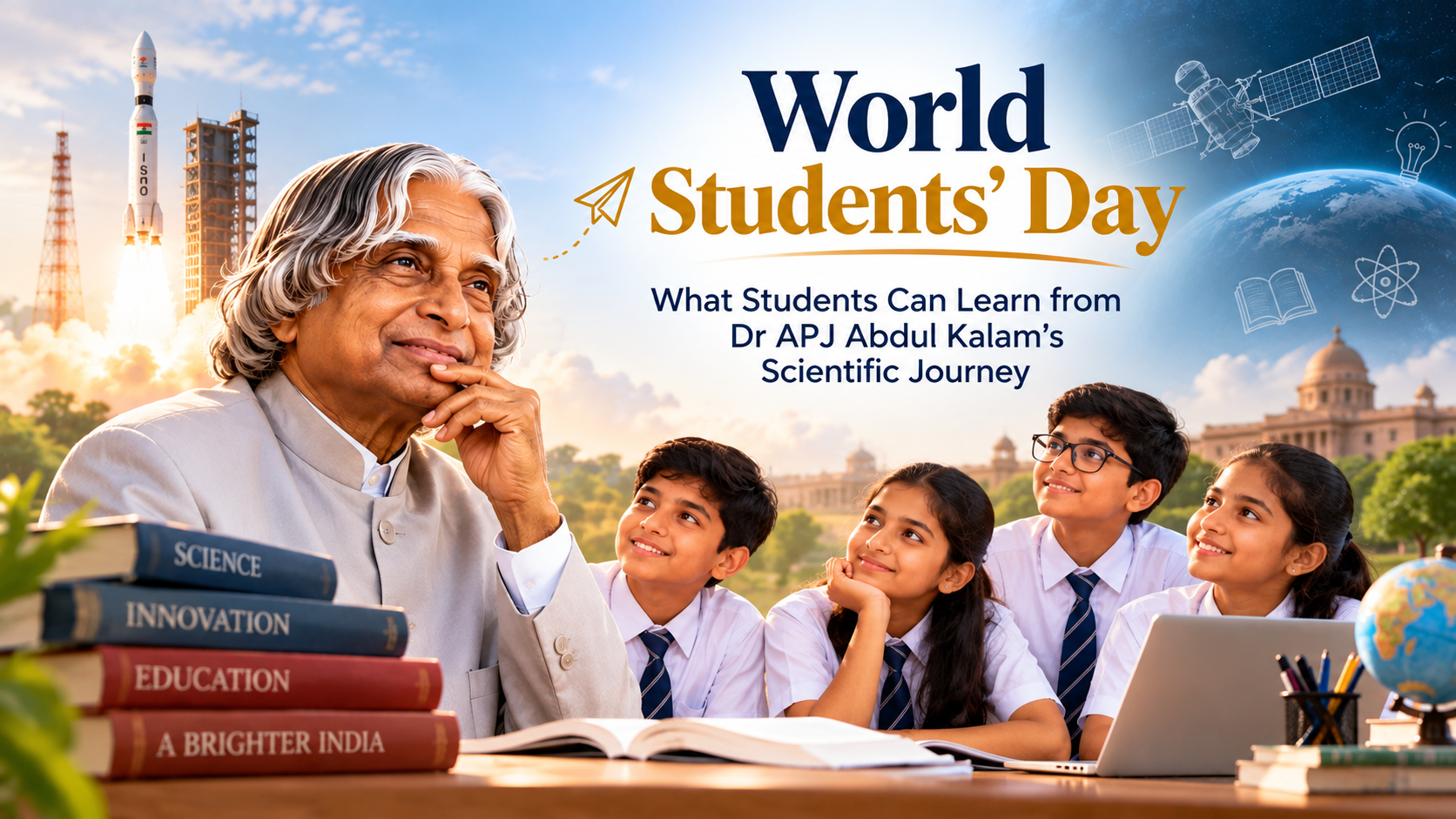
Every year on 15 October, the birth anniversary of Dr APJ Abdul Kalam is widely celebrated in India as World Students' Day. It is an opportunity to remember a remarkable scientist, educator and former President of India who believed in the importance of education, scientific curiosity and young minds.
Dr Kalam's journey from a student in Rameswaram, Tamil Nadu, to becoming one of India's most recognised scientists offers valuable lessons for school students.
His achievements were not built overnight. They were shaped by education, continuous learning, teamwork and a strong interest in understanding how things work.
For students, learning about his scientific journey can make science more interesting while showing how classroom knowledge can contribute to real-world discoveries.
Dr Avul Pakir Jainulabdeen Abdul Kalam was born on 15 October 1931 in Rameswaram, Tamil Nadu.
He developed an interest in learning from an early age and later studied physics at St Joseph's College, Tiruchirappalli. He subsequently pursued aerospace engineering at the Madras Institute of Technology.
His interest in aircraft, engineering and scientific development eventually led him to work on important national projects.
Dr Kalam served as the 11th President of India from 2002 to 2007. However, his contributions to science and technology remain an important part of his legacy.
Dr Kalam's scientific career began at the Defence Research and Development Organisation (DRDO). He later joined the Indian Space Research Organisation (ISRO), where he became involved in India's satellite launch vehicle programme.
His work required knowledge of physics, mathematics, engineering and technology.
These were not subjects studied separately in the workplace. Scientists and engineers had to combine their knowledge to solve practical problems.
This provides an interesting lesson for students: the concepts they learn in school can become useful tools for understanding and developing real technologies.
One of Dr Kalam's major contributions was his role as Project Director of India's first indigenous Satellite Launch Vehicle, SLV-3.
In July 1980, SLV-3 successfully placed the Rohini satellite into orbit.
This achievement marked an important stage in India's development of satellite launch capabilities.
The project involved scientists, engineers and technical teams working together over several years.
For students, this achievement demonstrates how scientific projects depend on careful planning, experimentation, testing and cooperation.
It also shows that scientific progress often requires repeated efforts before a successful result is achieved.
After his contributions to the space programme, Dr Kalam played an important role in India's defence research and missile development initiatives.
He became closely associated with the Integrated Guided Missile Development Programme, which involved the development of indigenous missile systems.
His contributions earned him the popular title "Missile Man of India."
Students can learn from this part of his career that large scientific projects involve several areas of expertise.
Engineers, researchers, technicians and project teams must work together to develop, test and improve complex technologies.
One of the most useful lessons from Dr Kalam's journey is the importance of curiosity.
Scientific learning begins when students become interested in understanding the world around them.
A student may wonder why an aircraft can fly, how a satellite stays in orbit or how a rocket moves through the atmosphere.
These questions can lead to an interest in physics, mathematics, engineering and other scientific subjects.
Students do not need advanced equipment to begin exploring science.
Simple classroom experiments, science exhibitions, educational models and observations can encourage them to ask questions and look for explanations.
Scientific achievements are rarely the result of one person's efforts.
Dr Kalam worked with large teams of scientists, engineers and researchers throughout his career.
Space missions and engineering projects require people with different skills to contribute towards a shared objective.
This provides an important lesson for school students.
Whether they are participating in a science exhibition, preparing a group presentation or working on a classroom project, learning to cooperate can help them understand different ideas and responsibilities.
Students can also discover that listening to others and sharing knowledge are important parts of completing a project successfully.
Scientific experiments do not always produce the expected results.
India's first experimental SLV-3 launch in 1979 did not achieve its intended objective. The team studied the problems, continued its work and achieved a successful launch in 1980.
This experience is an important example of how scientific development involves testing, analysing results and making improvements.
Students can apply a similar approach when working on science experiments or challenging academic activities.
An unexpected result does not always mean that an activity has no value. It may provide useful information about what needs to be understood or changed.
Dr Kalam maintained a strong interest in interacting with students and encouraging young people to pursue education.
He regularly addressed students and spoke about scientific thinking, learning and the importance of developing knowledge.
He believed that education could help young people contribute to society through their abilities and ideas.
His interactions with students are one reason his birth anniversary continues to hold special meaning in many educational institutions.
For school students, his life offers an opportunity to understand how learning can continue beyond examinations and classrooms.
Students inspired by Dr Kalam's scientific journey can develop their interest through everyday educational activities.
Preparing a working model or explaining a scientific concept can help students understand how theories are applied in practical situations.
Learning about scientists such as C. V. Raman, Vikram Sarabhai, Homi J. Bhabha and Dr APJ Abdul Kalam can introduce students to different areas of scientific research.
Students can learn about satellites, rockets, planetary missions and India's space programme through age-appropriate educational resources.
Students can develop a deeper understanding of scientific concepts by asking why something happens rather than memorising an explanation alone.
Group experiments and classroom activities can introduce students to the importance of teamwork, planning and shared responsibility.
World Students' Day, as widely observed in India on 15 October, provides an opportunity to celebrate learning and remember Dr Kalam's connection with students.
Schools can use the occasion to introduce children to his scientific achievements and encourage discussions about science, innovation and education.
Activities such as science quizzes, educational presentations, exhibitions and discussions about Indian scientists can make the occasion informative and engaging.
Rather than focusing only on motivational messages, students can explore the actual scientific work that made Dr Kalam an important figure in India's technological development.
Dr APJ Abdul Kalam's journey demonstrates how education, curiosity, scientific knowledge and teamwork can contribute to significant achievements.
His contributions to India's space and defence programmes remain an important part of the country's scientific history.
On World Students' Day 2026, students can remember his legacy by learning about his discoveries, exploring scientific ideas and developing an interest in understanding the world around them.
At Sri Viswasanthi Schools, encouraging scientific curiosity, practical learning and general knowledge can help students appreciate the value of education while drawing inspiration from the achievements of Dr APJ Abdul Kalam.
Monday - Friday : 9am - 4pm
Saturday : 9am - 1pm

