

For Enquiry
9948984444
9247456148
SRI VISWASANTHI EDUCATIONAL INSTITUTIONS
Near Vijayawada,Vuyyuru - 521 165,
Krishna Dt. (A.P.), India
FOR MORE DETAILS GIVE MISSED CALL TO
9247456148, 9948984444
Every country has its own culture, traditions, languages and priorities. However, many challenges faced by the world cannot be solved by one country alone. Issues such as climate change, environmental protection, international peace, education and public health require nations to communicate and work together.
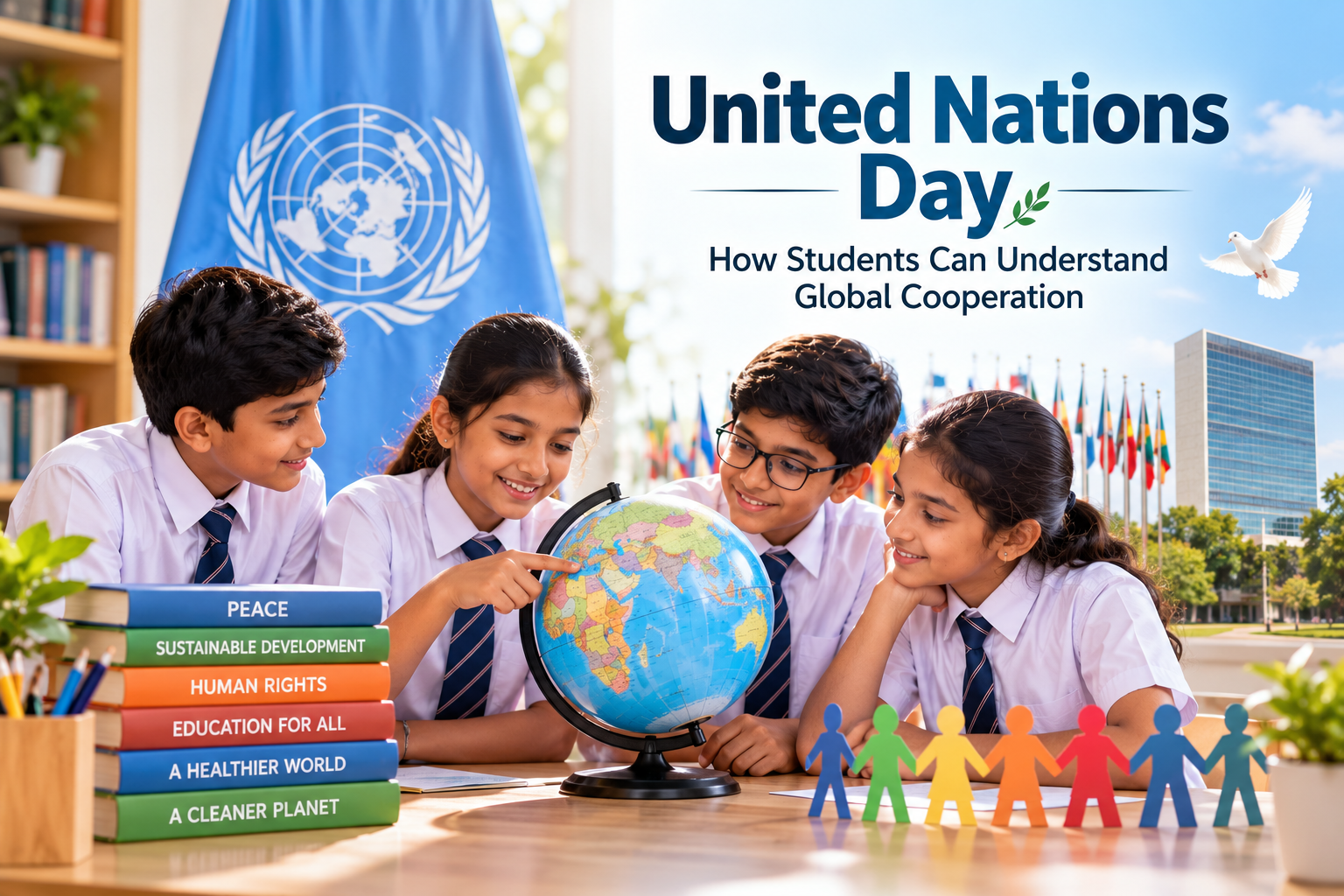
United Nations Day, observed every year on 24 October, provides an opportunity for students to understand the importance of international cooperation and how countries work towards common goals.
For school students, learning about the United Nations helps connect classroom subjects such as history, geography, civics and environmental science with real-world events. It also encourages awareness of the responsibilities people share as members of a global community.
United Nations Day marks the anniversary of the United Nations Charter coming into force on 24 October 1945.
The United Nations, commonly known as the UN, was established after the Second World War to encourage peaceful relations among countries and promote international cooperation.
Today, the organisation has 193 Member States and provides a platform where countries can discuss international issues, share perspectives and work towards collective solutions.
United Nations Day reminds people of the importance of dialogue, cooperation and shared responsibility in addressing global challenges.
For students, it is an opportunity to explore how international organisations function and why cooperation between countries matters.
The United Nations works across several important areas that affect people around the world.
Its main purposes include:
Maintaining international peace and security.
Developing friendly relations among nations.
Encouraging cooperation on economic, social, cultural and humanitarian issues.
Promoting respect for human rights.
Providing a platform where countries can coordinate their efforts.
Although countries may have different interests and opinions, the UN offers opportunities for discussion and negotiation.
Students can understand this concept by comparing it with classroom activities where individuals work together to achieve a common objective despite having different ideas.
Global cooperation means countries, organisations and communities working together to address issues that affect more than one nation.
In today's interconnected world, decisions and events in one country can influence people living elsewhere.
For example, changes in the global climate can affect agriculture, rainfall and natural ecosystems across different regions.
Similarly, scientific discoveries, international trade and technological developments often involve contributions from multiple countries.
Understanding these connections helps students recognise that the world functions through relationships between people, places and institutions.
One of the important purposes of the United Nations is to encourage peaceful solutions to international disagreements.
Countries may experience disputes over borders, resources, political issues or other concerns.
International discussions and diplomatic efforts can help countries communicate and explore possible solutions.
The United Nations also supports peacekeeping operations in certain conflict-affected regions, under mandates established by the UN Security Council.
What students can learn: Peaceful communication, listening to different viewpoints and resolving disagreements through discussion are valuable skills in both international relations and everyday school life.
Environmental challenges often extend beyond national boundaries.
Air pollution, ocean pollution, climate change and biodiversity loss can affect ecosystems and communities in several countries.
International cooperation allows nations to share scientific research, develop environmental agreements and coordinate conservation efforts.
The United Nations supports global environmental discussions through organisations and programmes such as the United Nations Environment Programme (UNEP).
Students can connect these global initiatives with environmental science lessons and everyday activities such as conserving water, reducing unnecessary waste and understanding the importance of natural resources.
Education plays an important role in helping individuals develop knowledge, skills and opportunities.
However, access to quality education varies across countries and communities.
United Nations organisations such as UNESCO and UNICEF contribute to international efforts related to education, children's welfare and learning opportunities.
Their work includes supporting educational development, sharing research and helping countries address challenges affecting learners.
For school students, understanding these efforts can create awareness of why education is considered an important part of social development.
It also demonstrates how international organisations can support countries in addressing shared educational challenges.
Public health challenges can affect people across national borders.
The spread of infectious diseases, access to essential healthcare and the need for reliable health information are examples of issues that benefit from international cooperation.
The World Health Organization (WHO), a specialised agency of the United Nations, works with countries and health institutions on international public health matters.
Its activities include providing technical guidance, supporting disease monitoring and coordinating responses to health emergencies.
What students can learn: Scientific research, communication and the sharing of reliable information are important when communities and countries respond to health challenges.
Earthquakes, floods, cyclones and other natural disasters can cause significant damage to communities.
When major disasters occur, affected countries may require additional resources, technical assistance or humanitarian support.
International organisations and neighbouring countries can contribute through relief supplies, medical assistance, logistical support and recovery efforts.
The United Nations Office for the Coordination of Humanitarian Affairs (OCHA) helps coordinate international humanitarian responses in major emergencies.
Students can learn how geography, science, transportation and communication systems are connected to disaster management.
This understanding is particularly relevant when studying natural hazards and preparedness in school.
An important topic associated with the United Nations is the Sustainable Development Goals (SDGs).
In 2015, UN Member States adopted 17 Sustainable Development Goals as part of the 2030 Agenda for Sustainable Development.
These goals address global priorities such as:
Ending poverty and hunger.
Promoting good health and quality education.
Improving access to clean water and sanitation.
Supporting affordable and clean energy.
Encouraging responsible consumption and production.
Taking action on climate change.
Protecting life on land and below water.
Promoting peaceful and inclusive societies.
The SDGs help students understand that social, economic and environmental issues are often interconnected.
For example, access to clean water can influence public health, while education can contribute to opportunities for employment and community development.
India was among the original members of the United Nations in 1945.
Over the decades, India has participated in UN discussions, contributed personnel to UN peacekeeping operations and engaged in international initiatives relating to development, health and environmental protection.
India's participation provides students with an opportunity to understand how their country interacts with the international community.
It also connects lessons about Indian history and civics with the broader study of international relations.
Students do not need to participate in international meetings to understand the principles of cooperation.
They can begin by developing habits that encourage communication, responsibility and respect for different perspectives.
Working with classmates on projects helps students practise sharing responsibilities, listening to ideas and solving problems together.
Exploring world maps, cultures, languages and historical events can help students understand the diversity of the global community.
Age-appropriate classroom discussions about environmental protection, education and public health can encourage students to examine issues from different viewpoints.
Students can practise expressing their views respectfully while understanding that others may approach the same issue differently.
Learning about the United Nations, UNESCO, UNICEF and WHO can introduce students to different forms of international cooperation.
These activities can help students connect global concepts with their everyday learning experiences.
Schools can use United Nations Day to introduce students to international cooperation through engaging educational activities.
World Map Activity: Students can identify UN Member States and locate different countries on a world map.
Model United Nations Discussion: Older students can participate in a simplified classroom discussion where they represent different countries and explore a shared global issue.
Sustainable Development Goals Presentation: Students can select one SDG and explain its importance using practical examples.
International Organisations Quiz: A quiz about the UN, UNESCO, UNICEF and WHO can improve students' general knowledge.
Global Challenges Poster Activity: Students can prepare informative posters about environmental conservation, access to education or responsible resource use.
Such activities encourage research, communication, teamwork and an understanding of international issues.
Students today have access to information about events and developments across the world.
Understanding global cooperation helps them interpret this information with greater awareness.
It also encourages them to recognise connections between local communities and international developments.
Subjects such as geography, history, civics, economics and science become more meaningful when students understand how they relate to real-world challenges.
Developing global awareness does not mean overlooking local responsibilities. Instead, it helps students understand how responsible actions at different levels can contribute to wider goals.
United Nations Day 2026 reminds students that countries are connected through shared challenges, responsibilities and opportunities.
From promoting peace and protecting the environment to supporting education and responding to humanitarian emergencies, international cooperation plays an important role in addressing global concerns.
By learning about the United Nations and its activities, students can develop a broader understanding of world affairs, appreciate different perspectives and recognise the importance of working towards common goals.
At Sri Viswasanthi Schools, connecting classroom education with global awareness helps students explore the relationship between knowledge, responsibility and cooperation. Observing occasions such as United Nations Day offers a meaningful opportunity to encourage curiosity about the world and help young learners understand the value of working together across communities and nations.
Monday - Friday : 9am - 4pm
Saturday : 9am - 1pm

