


For Enquiry
9948984444
9247456148

SRI VISWASANTHI EDUCATIONAL INSTITUTIONS
Near Vijayawada,Vuyyuru - 521 165,
Krishna Dt. (A.P.), India
FOR MORE DETAILS GIVE MISSED CALL TO
9247456148, 9948984444
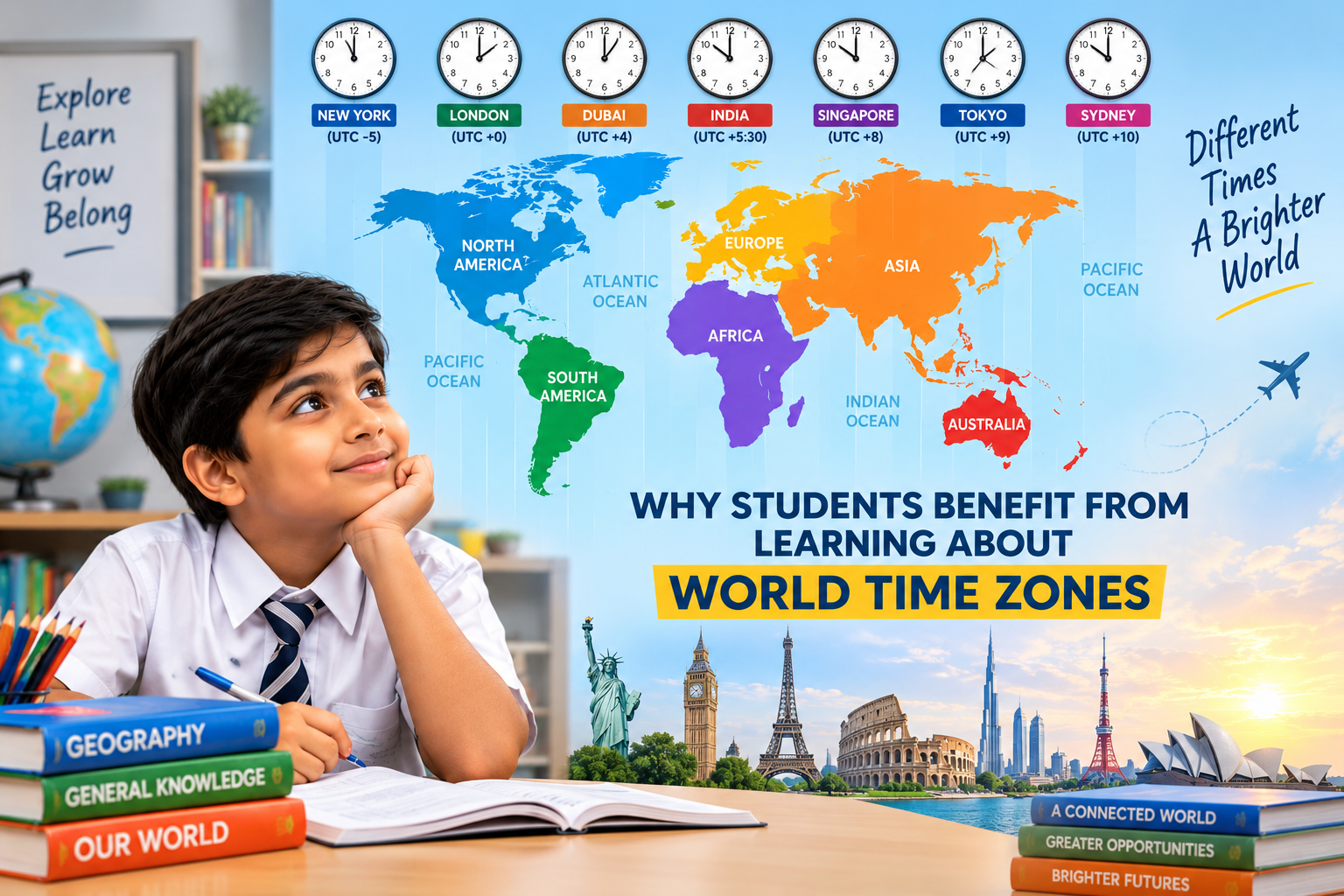
Students live in an increasingly connected world. They may watch an international sporting event, speak to relatives living in another country, follow news from overseas or attend an online programme involving people from different parts of the world.
One simple question often comes up in these situations: Why is the time different in different countries?
Learning about world time zones gives students an interesting way to understand how the Earth is divided into different areas of local time. It also introduces them to geography, travel and the way people around the world stay connected.
A time zone is a region where people generally follow the same standard time.
The Earth is divided into different time zones because different parts of the planet face the Sun at different times as the Earth rotates.
For example, when it is daytime in India, another part of the world may still be experiencing night. This is why people in different countries can have different local times at the same moment.
The Earth rotates on its axis once approximately every 24 hours. As it rotates, different parts of the planet move into and out of sunlight.
To make time easier to organise, the world is divided into time zones based broadly on longitude.
The Prime Meridian, which passes through Greenwich in the United Kingdom, is used as the starting reference for measuring longitude and world time.
This provides students with a useful connection between geography and everyday timekeeping.
Learning about time zones can make geography more meaningful.
Instead of seeing countries simply as places on a map, students can begin to understand how their location affects daily life.
They can ask questions such as:
These questions can encourage students to explore the world with greater curiosity.
India follows Indian Standard Time (IST), which is based on 82.5° east longitude.
When students compare Indian Standard Time with the local time in another country, they can see how geographical location affects the clock.
For example, an online meeting scheduled with someone living overseas may need to be planned according to both locations.
This gives students a simple real-life example of why understanding time zones can be useful.
Time zones become especially noticeable when people travel across countries or continents.
A journey can take several hours, but the clock at the destination may show a very different time from the clock at home.
Students who understand time zones can begin to understand why travellers sometimes need to adjust their routines after crossing several time zones.
It can also help them read travel schedules and understand the local time at their destination.
Modern communication connects people across different parts of the world.
Students may participate in online competitions, virtual learning sessions, international cultural programmes or conversations with friends and relatives living abroad.
Knowing about time zones can help them understand why an event that takes place in the afternoon in one country might happen in the evening or at night somewhere else.
This is a useful example of how geography influences modern communication.
International sporting events, award ceremonies, launches and other programmes often attract audiences from around the world.
The same event can take place at one particular moment, but people in different countries may watch it at different local times.
Understanding time zones helps students make sense of these differences instead of wondering why the event appears at a different time on their local schedule.
Geography is not only about memorising countries, capitals and physical features. It also helps students understand how the world works.
Time zones provide a practical example.
Students can combine their knowledge of:
This makes a familiar concept—time—into an opportunity to explore the wider world.
Understanding different time zones can also help students develop a broader awareness of life beyond their immediate surroundings.
A student may begin to realise that while they are getting ready for school, another student somewhere else may already be finishing their school day.
This simple idea can encourage children to think about different communities, cultures and daily routines around the world.
Teachers and parents can make the topic engaging through simple activities.
Students can choose a few cities from different continents and compare their local times. They can create a world map showing selected time zones or investigate when an international event will take place in their local time.
These activities can turn a geography lesson into an interactive exploration of the world.
Learning about world time zones may seem like a small piece of general knowledge, but it connects students with geography, travel, communication and global events.
It also teaches an important lesson: the world operates according to different local times, even though everyone shares the same planet.
By understanding why these differences exist, students can become more curious about the world around them and more comfortable navigating an increasingly connected global environment.
At Sri Viswasanthi Schools, introducing students to practical general knowledge can help them connect classroom learning with the wider world and develop a stronger sense of global awareness.
Monday - Friday : 9am - 4pm
Saturday : 9am - 1pm

