


For Enquiry
9948984444
9247456148

SRI VISWASANTHI EDUCATIONAL INSTITUTIONS
Near Vijayawada,Vuyyuru - 521 165,
Krishna Dt. (A.P.), India
FOR MORE DETAILS GIVE MISSED CALL TO
9247456148, 9948984444
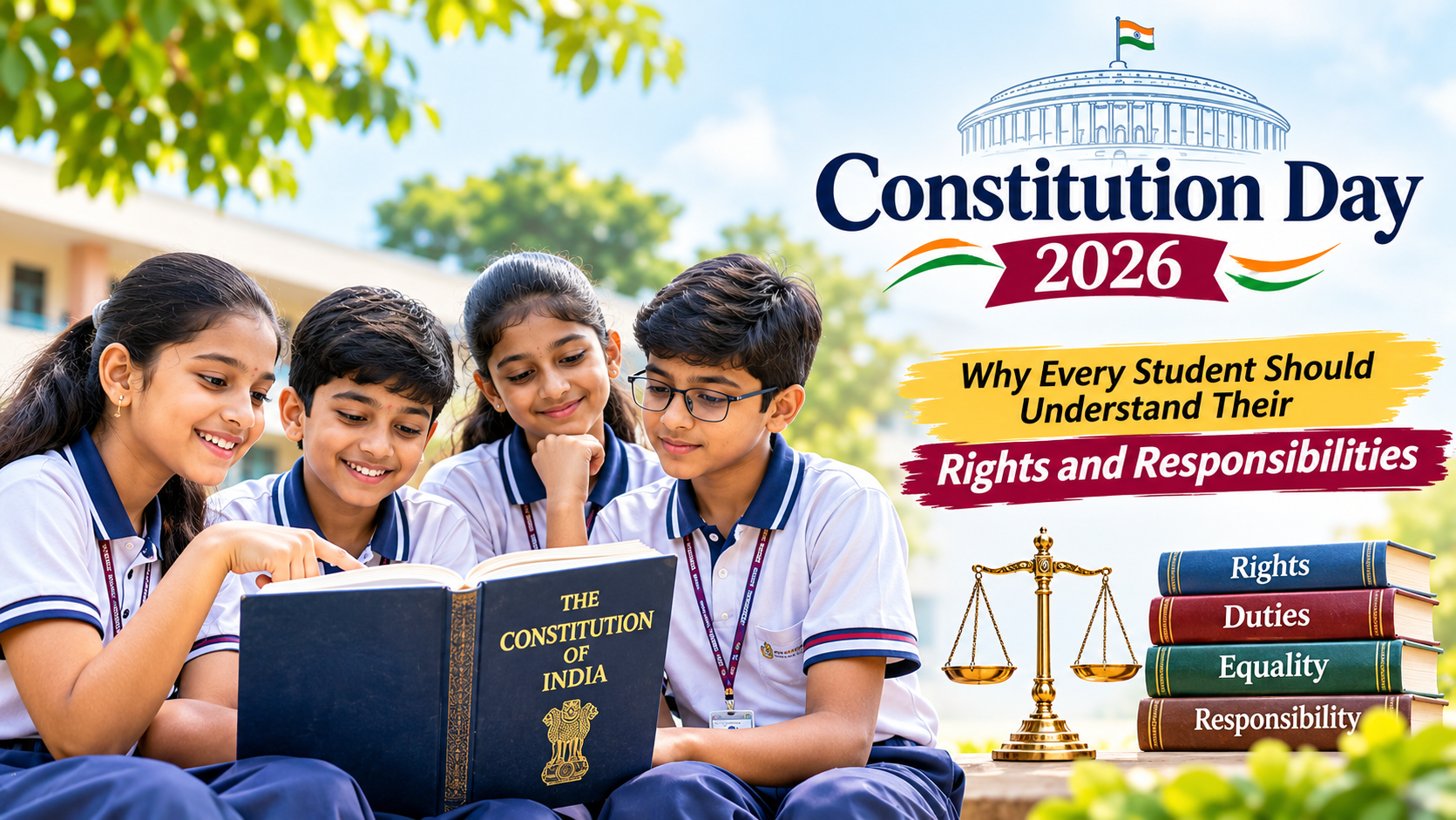
Every student is part of a larger community where values such as equality, respect, fairness and responsibility play an important role. Understanding these values from an early age helps children develop positive attitudes towards others and become responsible members of society.
Constitution Day 2026, observed in India on 26 November, provides an opportunity for students to learn about the Indian Constitution and understand how it influences everyday life.
The Constitution is not simply a document containing laws and regulations. It establishes the principles that guide our democracy, protects fundamental rights and outlines the responsibilities of citizens.
For school students, learning about the Constitution is an important step towards developing civic awareness, understanding democratic values and recognising their role in building a respectful and inclusive society.
Constitution Day, also known as Samvidhan Divas, is observed across India every year on 26 November.
On 26 November 1949, the Constituent Assembly adopted the Constitution of India. It subsequently came into effect on 26 January 1950, the day celebrated as Republic Day.
In 2015, the Government of India officially designated 26 November as Constitution Day to promote awareness of constitutional values and recognise the significance of the Constitution.
The occasion also honours the contribution of Dr B. R. Ambedkar, who served as Chairman of the Drafting Committee of the Constituent Assembly.
Schools and educational institutions may observe Constitution Day through Preamble readings, discussions, quizzes, debates and other educational activities.
These experiences can help students understand how constitutional principles relate to their lives.
Students may initially view the Constitution as a subject related only to politics, government or legal studies.
However, its principles influence many aspects of everyday life, including equality, education, freedom, dignity and respect for others.
Learning about the Constitution can help students:
Understand the importance of equality and fairness.
Recognise the rights and responsibilities of citizens.
Respect people from different backgrounds and communities.
Develop awareness of democratic values.
Learn the importance of following rules and respecting others.
Become thoughtful and responsible members of society.
When constitutional values are introduced through simple explanations and practical examples, students can understand their relevance beyond textbooks.
Fundamental Rights are important protections guaranteed by Part III of the Indian Constitution.
They help safeguard individual freedoms, promote equality and protect people against certain forms of discrimination and exploitation.
Students can begin learning about these rights through everyday examples.
The Right to Equality promotes equal treatment before the law and prohibits certain forms of discrimination.
In school life, students can understand this principle by treating classmates fairly, respecting differences and ensuring that everyone has opportunities to participate.
For example, including classmates in group activities regardless of their language, background or personal differences reflects the value of equality.
The Constitution protects several freedoms, including freedom of speech and expression, subject to constitutional restrictions.
Students can learn that expressing opinions is important, but communication should also be respectful and responsible.
Classroom discussions provide opportunities for students to share ideas, listen to different viewpoints and disagree politely.
This right includes protections against trafficking, forced labour and certain forms of child labour.
Students can learn why children deserve protection from exploitation and why education, safety and wellbeing are important.
India is home to people who follow different religions and traditions.
The Constitution protects freedom of conscience and religious freedom, subject to constitutional provisions.
Students can practise respect by learning about different traditions and treating classmates with dignity.
These rights protect important cultural and educational interests, particularly those of minorities.
Students can understand their significance by appreciating India's linguistic and cultural diversity.
This right allows people to approach the Supreme Court for the enforcement of Fundamental Rights.
For school students, the key lesson is that rights are protected through constitutional processes and legal institutions.
Article 21A provides for free and compulsory education for children between the ages of six and fourteen, in the manner determined by law.
This provision highlights the importance of access to elementary education.
Students can understand education as an opportunity that helps them develop knowledge, skills and the ability to participate meaningfully in society.
Along with Fundamental Rights, the Constitution also identifies Fundamental Duties under Article 51A.
These duties encourage citizens to uphold constitutional values, respect the nation and contribute positively to society.
Although the Constitution lists eleven Fundamental Duties, students can begin by understanding those most relevant to everyday life.
Students can learn the importance of respecting the Constitution, the National Flag and the National Anthem.
Understanding their significance encourages national awareness and responsible conduct.
India has a rich diversity of languages, cultures, traditions and communities.
Students can contribute to harmony by treating others respectfully, avoiding discrimination and developing positive relationships.
The Constitution encourages citizens to protect and improve the natural environment.
Students can practise this responsibility by conserving water, reducing waste, caring for plants and keeping their surroundings clean.
One of the Fundamental Duties encourages the development of scientific temper, humanism and the spirit of inquiry and reform.
Students can practise this through questioning, observing, experimenting and approaching information thoughtfully.
Students can learn the importance of taking care of shared facilities.
Keeping classrooms clean, handling library books responsibly and avoiding damage to school property are practical examples.
The Constitution encourages citizens to strive towards excellence in individual and collective activities.
For students, this can mean approaching studies, sports, creative activities and personal responsibilities with dedication and a willingness to improve.
Rights and responsibilities are closely connected, but they serve different purposes.
Rights provide constitutional protections and freedoms.
Responsibilities encourage individuals to act thoughtfully and contribute positively to society.
For example, students should have opportunities to express their ideas, but they should also respect the opinions of others.
Similarly, students benefit from a safe and supportive learning environment, while sharing responsibility for treating classmates respectfully and following reasonable school rules.
Understanding this relationship helps children recognise that individual freedom and consideration for others are both important.
Constitutional principles become easier to understand when students connect them with familiar situations.
Students can demonstrate fairness by including others in activities and avoiding discriminatory behaviour.
Classroom discussions teach students to listen carefully, express ideas clearly and respect different perspectives.
Reasonable school rules help maintain an organised and safe learning environment.
Following them encourages discipline and consideration for others.
Helping a classmate understand a lesson or participate in an activity promotes cooperation and empathy.
Keeping classrooms, playgrounds and libraries clean encourages respect for common resources.
These everyday actions help students practise values associated with responsible citizenship.
Every child deserves dignity, respect and meaningful opportunities to learn.
Schools bring together students with different interests, abilities, experiences and backgrounds.
This diversity creates opportunities for children to understand different perspectives and develop positive social relationships.
When students practise equality and mutual respect, they contribute to a more welcoming learning environment.
They also develop communication, empathy and cooperation skills that are valuable throughout life.
Constitution Day offers an opportunity to discuss why fairness and inclusion are essential in both schools and society.
Democracy is based on principles such as participation, representation, accountability and respect for differing opinions.
Students can begin understanding these ideas through age-appropriate classroom activities.
For example, a classroom discussion about selecting a group activity can demonstrate the importance of listening to different preferences.
Student councils and other representative activities, where available, can provide opportunities to understand leadership and collective decision-making.
Debates and group discussions can help students learn to present arguments respectfully and consider alternative viewpoints.
These experiences encourage students to understand that democratic participation involves both expressing opinions and listening to others.
Constitution Day is also an opportunity to learn about the contribution of Dr Bhimrao Ramji Ambedkar.
As Chairman of the Drafting Committee, Dr Ambedkar played a central role in preparing the draft Constitution.
He was a prominent jurist, economist, social reformer and advocate for equality and social justice.
His work highlighted the importance of constitutional safeguards, education and the protection of individual dignity.
Students can learn valuable lessons from his commitment to knowledge, equality and social reform.
Learning about Dr Ambedkar also helps students appreciate the contributions of the wider Constituent Assembly, whose members debated and shaped the Constitution.
Schools can make Constitution Day educational and engaging through activities that encourage participation and understanding.
Students can read the Preamble to the Constitution and discuss the meaning of words such as justice, liberty, equality and fraternity.
Age-appropriate quizzes can introduce students to important constitutional facts, dates and personalities.
Students can create posters highlighting equality, unity, responsibility and respect for diversity.
Teachers can encourage students to discuss how fairness, cooperation and responsibility apply to everyday situations.
Topics such as My Responsibilities as a Student or Why Equality Matters can help children express their understanding.
Students can act out everyday situations involving fairness, teamwork and respectful communication.
Classrooms can organise simple activities such as waste segregation awareness, water conservation discussions or supervised planting initiatives.
These activities can help students connect constitutional values with practical behaviour.
Parents play an important role in helping children understand fairness, respect and responsible behaviour.
Constitutional values can be introduced through simple conversations and daily experiences.
Encourage Respectful Communication: Allow children to express opinions while teaching them to listen to others.
Explain Fairness Through Examples: Discuss why everyone deserves respect and why discrimination is unacceptable.
Introduce Age-Appropriate Responsibilities: Encourage children to care for their belongings, complete suitable household tasks and respect shared spaces.
Discuss Diversity Positively: Help children appreciate different languages, traditions and cultural practices.
Encourage Questions: Support curiosity about society, laws, rights and responsibilities through age-appropriate explanations.
Lead by Example: Children often learn values by observing how adults treat others and respond to everyday situations.
These practices can help children understand that responsible citizenship begins with everyday behaviour.
Understanding constitutional values contributes to more than civic knowledge.
It can also support students' personal and social development.
When children learn about rights and responsibilities, they develop a stronger awareness of how their actions affect others.
Discussions about equality and fairness can encourage empathy and respectful relationships.
Learning about democratic participation can support communication and critical-thinking skills.
Understanding environmental duties can encourage responsible habits and awareness of sustainability.
Most importantly, constitutional education helps students recognise that they are members of a diverse society in which dignity, cooperation and mutual respect matter.
These lessons can support the development of thoughtful, informed and responsible individuals.
Constitution Day 2026 reminds us that the values of the Indian Constitution are relevant to people of all ages, including school students.
Understanding Fundamental Rights helps children recognise the importance of equality, freedom, dignity and protection.
Learning about Fundamental Duties encourages them to respect others, care for the environment, protect shared resources and develop a spirit of inquiry.
When students connect these principles with everyday experiences, constitutional awareness becomes a meaningful part of their education.
At Sri Viswasanthi Schools, we believe that education should support academic learning while encouraging values such as respect, responsibility, curiosity and cooperation. Constitution Day provides an opportunity to help students understand the principles that shape our democracy and recognise how positive everyday actions contribute to a better society.
This Constitution Day, let us encourage every student to understand their rights, embrace their responsibilities and grow into a thoughtful and responsible citizen.
Monday - Friday : 9am - 4pm
Saturday : 9am - 1pm

